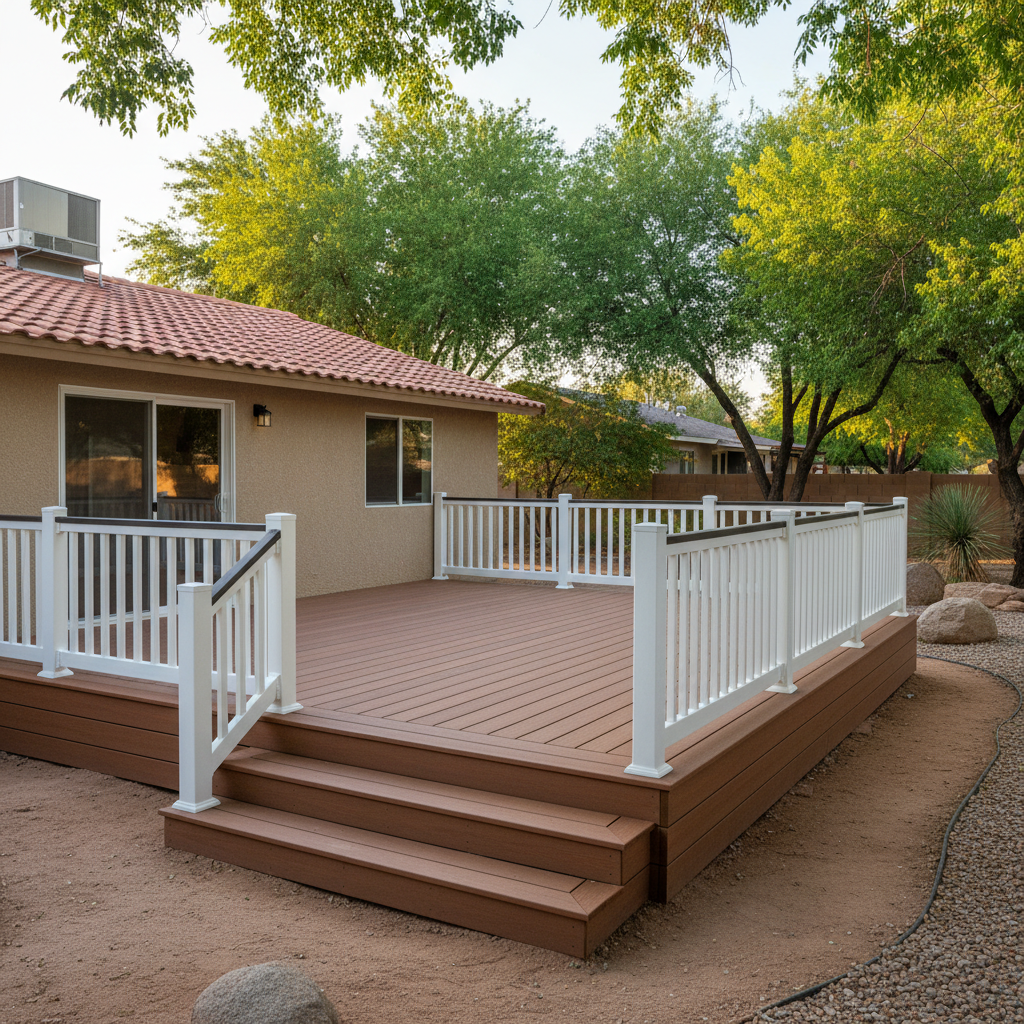
Composite Decking: Is It Worth the Investment Here in Apache Junction?
You're looking at composite decking, huh? Smart move. Around here, with our intense sun and those monsoon downpours, wood decks just get hammered. I've seen plenty of folks go with wood only to be staining and repairing it every couple of years, and honestly, who has time for that? Composite? It's a whole different ballgame. It holds up way better to our Apache Junction weather, but yeah, it's definitely going to cost you more upfront than a basic pressure-treated wood deck. Let's dig into what that 'more' actually looks like.
What Drives the Price of a Composite Deck?
When you're trying to figure out what your new composite deck will actually cost, there are a few big factors that really move the needle. It's not just the material itself; it's the whole shebang.
- Size and Shape: This is pretty obvious, right? A small, simple 10x10 square deck will be a lot cheaper than a sprawling 20x30 multi-level design with curves and intricate patterns. Every extra foot adds material and labor. Complex shapes mean more cuts, more waste, and more time for the crew to get it just right.
- Decking Material Grade: Not all composite is created equal, believe me. You've got your entry-level stuff, which usually comes in a solid color and might have a simpler cap. Then you step up to mid-range boards that often feature multi-tonal streaking to mimic wood grain and a more durable cap. The premium stuff? That's where you get the deep, rich colors, super realistic wood grain textures, and the thickest, most advanced protective caps. Think about brands like Trex, TimberTech, or Azek – they all have different lines at different price points. A basic composite board might run you $4-$6 per linear foot, while a premium capped polymer board can hit $8-$12+ per linear foot.
- Foundation and Framing: Our soil here in Apache Junction can be pretty rocky, especially if you're up near the Superstition Mountains. That can make digging footings a real pain and sometimes requires more robust concrete work. If your yard slopes, you might need taller posts or even a retaining wall, which, you guessed it, adds to the cost. We're always building to code, and that means solid foundations, no shortcuts.
- Railings: This is a big one, a surprisingly big one sometimes. Pressure-treated wood railings are the cheapest option, but they just don't last like composite. Aluminum railings are popular; they're sleek and durable, running about $60-$100 per linear foot installed. Composite railings will match your deck, often $50-$90 per linear foot. Glass panel railings or cable railings look fantastic and offer unobstructed views, but they're premium, easily $120-$200+ per linear foot.
- Add-ons and Features: Built-in benches, planters, custom lighting, pergolas, or even an outdoor kitchen integrated into the deck structure – these all add to the final price, naturally. Stairs are another cost factor; a simple set of three steps is one thing, but a grand staircase with landings and custom railings is a whole different ballgame.
Typical Cost Ranges for Composite Decks in Apache Junction
Alright, let's get down to some numbers. Remember, these are general ranges, and your specific project could be higher or lower depending on all those factors I just mentioned. But this should give you a solid ballpark, a jumping off point.
For a complete, installed composite deck here in Apache Junction, you're generally looking at anywhere from $45 to $80+ per square foot. That includes all materials (decking, framing, fasteners, basic railings) and labor.
- Basic Composite Deck (e.g., 12x12, simple design, entry-level composite, basic railing): You might see prices in the $6,500 - $10,000 range. This is for a straightforward, ground-level or low-level deck, nothing too fancy.
- Mid-Range Composite Deck (e.g., 16x20, slightly more complex shape, mid-grade composite, aluminum railings): This type of project typically falls into the $15,000 - $25,000 range. You're getting better aesthetics and durability here, a nice upgrade.
- Premium Composite Deck (e.g., 20x30 multi-level, premium capped polymer, custom railings, lighting, maybe a built-in bench): For a truly custom, high-end composite deck, you're looking at $30,000 and up. The sky's the limit here depending on how fancy you want to get – really, it is.
Keep in mind, these numbers are for the deck itself. If you're talking about extensive landscaping, a full outdoor kitchen, or a huge custom pergola, those are separate costs that can add significantly.
What Should a Quote From Apache Junction Deck Builders Include?
When you get a quote from us, or any reputable builder for that matter, it should be detailed. Don't just accept a one-line price; that's a red flag. You need to know what you're paying for. Here's what we typically break down:
- Detailed Material List: Specific type and brand of composite decking, framing lumber (e.g., pressure-treated pine), fasteners, concrete for footings, railing system components, and any other materials.
- Labor Costs: This covers everything from site prep and demolition (if needed) to framing, decking installation, railing installation, and cleanup.
- Permit Fees: Building permits are required by the city or county for most deck projects. We handle this, and the cost is usually included or clearly itemized.
- Foundation Work: Specifics on post holes, concrete, and any necessary grading or leveling.
- Railing System: Clearly define the type, material, and style of railing you've chosen.
- Stairs: Number of steps, width, and railing for the stairs.
- Any Add-ons: Lighting, benches, fascia, skirting, etc., should all be itemized.
- Warranty Information: Both for the materials (manufacturer's warranty) and for the workmanship (our warranty).
How to Avoid Overpaying for Your Composite Deck
Nobody wants to get ripped off, especially not on a big investment like a deck. Here's my advice for getting a fair price:
- Get Multiple Quotes: This is non-negotiable. Don't just go with the first guy you call; that's a rookie mistake. Get at least three detailed quotes from different licensed and insured contractors. This helps you compare apples to apples and understand the market rate.
- Be Specific About What You Want: The more details you can give a contractor upfront, the more accurate their quote will be. Have an idea of the size, shape, material grade, and any features you want. Pictures of decks you like are super helpful.
- Understand the Material Differences: Don't just ask for